
Developed from TNO practice
Control over building data.
buildinglinks is a trusted environment for secure, controlled sharing of building data, built on European dataspace principles.
Try the demo Get in touch
Your own dataspace in a few minutes, nothing to install. The demo is in Dutch.
One dataspace for every participant in the chain.
What is your role in the chain?
Control over portfolio data without new lock-in.
For institutional owners and owner-occupiers, building data sits scattered across BMS portals, FM providers, meters, tenants and reporting chains. buildinglinks makes that data usable in a controlled way for ESG, maintenance, comfort and optimisation without the owner losing control.
Today
- 01 Manual consolidation from dozens of portals and exports.
- 02 No portfolio-wide comparison without normalising measurement points, units and floor area.
- 03 CSRD, GRESB and EU Taxonomy substantiation demands auditable data series, not loose spreadsheets.
With buildinglinks
- 01 Automated data collection for ESG and CSRD reporting.
- 02 Portfolio-wide energy benchmarking with metering data straight from the source.
- 03 One overview of who uses which data from which building, and revoking access in a single action.
Decentralised dataspace
Buildinglinks coordinates trust and agreements. The data stays at the source.
Every participant has a connector. The control plane makes the agreements and checks the proofs; the data plane delivers the data, directly from the data holder to the data recipient. The Trust Authority admits participants and records evidence, but the data never passes through it.
rights holder
connector
control plane
data plane
data recipient
connector
control plane
data plane
Trust Authority
- Participants
- Membership
- Notary
data holder
connector
control plane
data plane
Every participant has a connector: self-hosted with Docker or Kubernetes, or managed by buildinglinks. The source code will be source-available (FSL), and the connector works with any connector that follows DSP and DCP.
Buildinglinks stores no building data.
Interoperability: one protocol for building data
Connect once, not per customer. From then on every building speaks the same language.
Building data travels through the dataspace in one format: the Buildinglinks protocol, with Brick classes for points, setpoints and equipment. A data holder translates its system to that protocol once, with an adapter, unless the system already speaks the protocol itself. An app gets the same format from every building, through the gateway of its own connector. The connectors pass the protocol on unchanged and check every request.
Why now
European legislation makes controlled sharing of building data no longer optional.
Building data will soon have to be generated, made accessible and accounted for by law — and the owner gains the right to share it. The law prescribes that it happens, not how it happens securely and demonstrably between parties. That gap is what buildinglinks fills.
A right to your own installation data.
The user of connected building installations is entitled to the data generated by their use and may have it shared with a third party of their choice. That touches BMS, EMS, meters and other smart installations as soon as they generate data as a connected product or related service.
Building automation becomes mandatory.
Utility buildings above 290 kW must have a building automation and control system; from the end of 2029 the threshold drops to 70 kW. The installed base is being made data-generating by law — but that data is stuck in closed systems.
Building information goes digital.
The EPBD pushes towards digital energy performance certificates, national building performance databases, renovation passports and data exchange. Building data must not only exist, but also become findable, explainable and shareable.
Directive (EU) 2024/1275 · transposed in the Dutch Bbl since 29 May 2026
Accountability per building, chain-wide.
Companies with more than 1,000 employees and over €450 million turnover report under ESRS on climate, energy use and emissions in their own operations and value chain. For real estate that means substantiation per building and traceable data from management, meters and installations.
CSRD / ESRS E1 · Directive (EU) 2022/2464, amended by Directive (EU) 2026/470
And the law describes the solution too
The Data Governance Act describes the neutral data intermediary.
The same European legislation describes the neutral intermediary that enables data sharing without using the data itself, as part of a Common European Data Space. buildinglinks follows that principle: the Trust Authority admits participants and records evidence, but never sees or uses the data.
Data Governance Act · Regulation (EU) 2022/868 · applicable since Sept 2023
Open European standards, tested with the official test suites.
buildinglinks follows the dataspace standards of the Eclipse Foundation and the eIDAS regulation. We test that the protocols are correct with Eclipse's official test suites (TCKs), against the real software.
Agreements between connectors
Requesting the catalogue, concluding an agreement, starting, pausing and ending a delivery.
Eclipse TCK 65/65
Identity and membership
Every connector presents a verifiable membership credential; suspension revokes it through a status list.
Eclipse TCK 117/117
Directing the data plane
The control plane directs the data plane, including that of a data holder in another organisation.
Eclipse TCK 26/26
Conditions
For whom, for what, until when, and whether control is allowed: machine-readable in every offer and agreement.
Signatures and timestamps
Joining with a qualified signature of an authorised signatory; qualified timestamps on the evidence.
Building data
Points, setpoints and equipment in the Buildinglinks protocol, using Brick classes.
Try it yourself
Your own dataspace, in a few minutes.
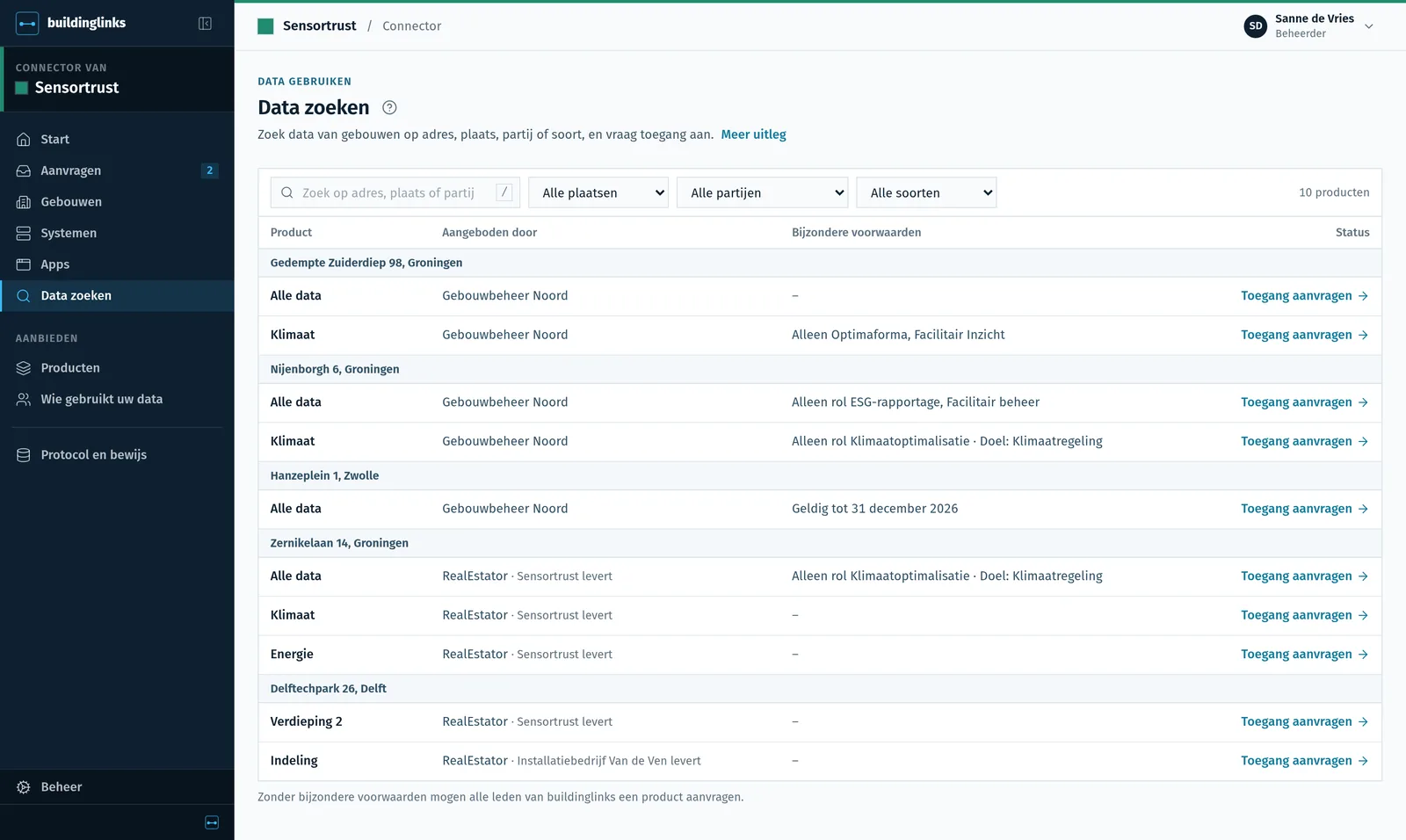
A complete dataspace, online and just for you: a Trust Authority, seven fictional organisations each with their own connector, simulated building management systems and apps. You are administrator everywhere and may change anything.
- 01 Offering, requesting and approving products: as owner, data holder or data recipient.
- 02 Delivering on behalf of someone else, and seeing who uses your data.
- 03 Apps that measure and control, with signed evidence of every step.
- 04 Registering a new organisation with the Trust Authority.
Sign up with your email address, nothing to install. The demo is in Dutch. After three days without use we clean up the dataspace.
For developers and architects
Run it yourself, check it yourself.
The connector runs as a container image, on Docker or Kubernetes. With the command line tool bl you start the same dataspace on your own computer, to connect your own systems and apps.
$ curl -fsSL https://github.com/buildinglinks/cli/releases/latest/download/bl-installer.sh | sh
$ bl sim start
Who is behind it
Developed from TNO practice.
You talk to us directly: about your buildings, your data and a first step.
Geert Lamerichs
CEO
Jan Taks
CTO
Herman Pals
Business development